
From Highlighter Pens to AI
What 14 Years in Bids Has Taught Me About Where This Profession Is Going
Chrissi West, Founder of BidQuest
This piece started life as a LinkedIn article. It sits alongside a theme I keep coming back to at BidQuest: bidding has become a strategic function, not an administrative one, and most of the failure points in a bid now sit upstream of the writing, in the strategy nobody quite finished setting.
Fourteen years ago, I sat around a table with two other writers, a bid manager, and a printed off tender pack thick enough to need its own chair. We read through it word-for-word as a team, highlighted requirements, scribbled notes in the margins, and divided the document up by hand. Our responses were mostly printed, along with digital copies saved on to discs, and posted back to the client, as well as the standard email submission. Portals existed, but I think it was still fairly early days. The bid manager assigned the writing, we went away and wrote it, and success was measured by how well we'd covered the requirements on the page.
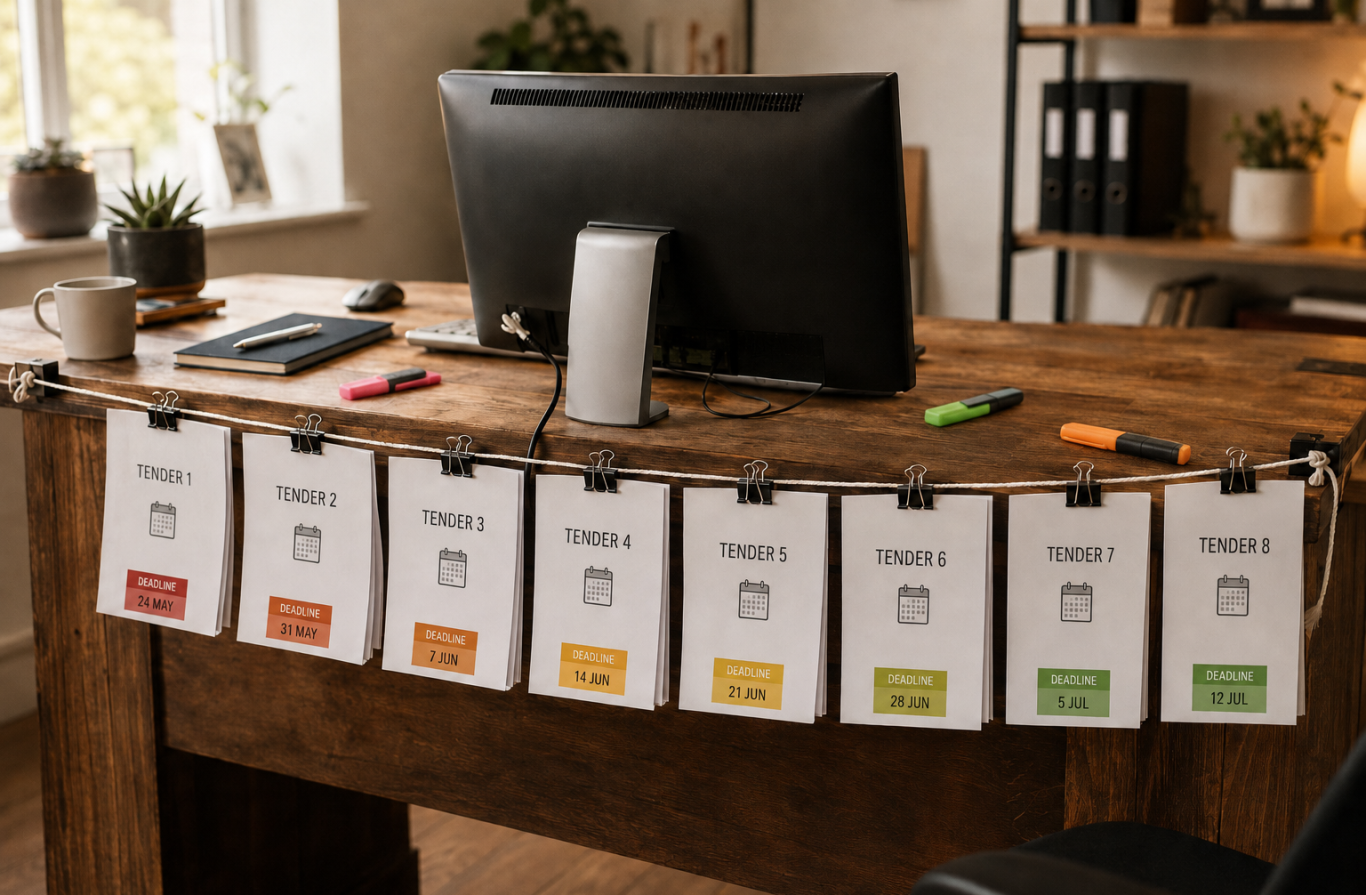
One technique I used to manage my workload back then still gets brought up by former colleagues, usually with a laugh: I had a piece of string running around my desk, held up with bulldog clips, and I'd peg my live tender packs to it in order of deadline. I called it my tender washing line. It looked ridiculous, but having every deadline staring back at me all day, in the right order, worked better than most systems I've used since. Post it notes did the rest. Everything back then was physical; now it's almost entirely digital.
That was bidding as an administrative craft; writing-led, paper-based, and largely invisible outside its own function. It's almost unrecognisable from the profession I work in today, and in my experience, it won't look anything like this again in another five years either.
I've moved through most of the seats in a bid team over that time; coordinator, writer, manager, senior bid manager building and transforming functions, before pivoting last year from a senior bid manager role at an AI and Digital Transformation company into consulting, helping SMEs and international companies navigate the Procurement Act and strengthen their approach to UK public sector growth. That vantage point, in house and now external, is what's convinced me this shift we're seeing is transformational for this profession. And it's what's convinced me of something else too: whatever else changes, the single biggest determinant of whether a bid wins or loses hasn't moved in fourteen years. It's the strategy behind it.
A few things have driven the wider shift.
Remote work gave bidding a seat at the table
The pandemic didn't just move bid teams out of the office. It changed who they could actually talk to.
Before, a bid kick-off meeting was attended by whoever happened to be in the building that day. Getting a senior stakeholder's input meant waiting for their next visit, or chasing them through a clunky email chain. Now, that same senior leader is one Teams call away, in the same virtual room as the writers, whenever the conversation needs to happen. Bid professionals have far broader reach across the business than they did when they were confined to a corner of the office, and far more visibility with the people who actually shape the strategy behind a pursuit.
And it wasn't only about being a call away. Chat functions and shared document tools opened up proper collaboration too; everyone able to see the latest version of a document, with good version control locking responsibility down to the right individuals, without the bid team's work staying hidden away where nobody else could see it. That's made a real difference to how bid professionals are viewed within an organisation. It's brought people into the process who previously didn't see themselves as having any relevance to bids at all, and it's pushed organisations a step closer to realising that the responsibility for a bid stretches well beyond the bid team alone.
It's also made a genuinely stressful, deadline driven job more liveable. Bid work needs long, uninterrupted blocks of concentration; the kind that's hard to protect when people keep wandering past your desk for a chat. Working from home has given people that flexibility, and a much better work life balance, without sacrificing the deadline discipline the job demands.
So what does this really mean in practice? Bidding stopped being something that happened in a room at the end of a corridor and started happening in the same conversations as sales and leadership. That's not a small shift. It's the beginning of bidding being treated as a strategic function rather than an administrative one.
AI didn't replace the bid writer, it exposed what the role was missing
AI can get you a first draft faster and cheaper than at any point in this profession's history. But a fast first draft isn't the same as a good one, and it still needs careful, skilled management to become something you'd actually submit.
That's the tension eroding the traditional bid writer role. It's not that writing has become redundant; it's that pure drafting is no longer enough to justify the role on its own. Writers are being pushed to lean on the parts of their skill set that used to sit outside their remit, or that they never had time for: quality control, strategic judgement, stakeholder management, tool fluency. The ones treating this as a skills upgrade are becoming more valuable than ever. The ones resisting it are the ones I see struggling to find their next role.
This is also, I think, part of why recruiters keep saying they can't find good bid writers right now. It's not that demand for the work has disappeared. It's that the job itself has quietly fractured, and the market hasn't quite caught up.
The Procurement Act is adding fuel, not just friction
The Procurement Act has changed the practical mechanics of bidding for SMEs in particular; more transparency, more market engagement, and more flexibility. An SME no longer has to lock in things like insurance levels upfront; they can commit if and when they win. That lowers the barrier to entry and is opening up public sector opportunities to organisations that previously found the process too front loaded and risky.
The knock-on effect is more opportunities landing on the desks of bid professionals at exactly the moment AI and remote working are making it possible to handle a heavier pipeline without heavier headcount. The timing isn't a coincidence; it's part of the same shift.
LinkedIn changed who bidding professionals could reach
Here's the one I didn't see coming fourteen years ago, and I'm still not sure if that's because it genuinely wasn't there yet or because I simply wasn't using it. Either way, LinkedIn has become unbelievably important to this profession, in a way that would have made no sense to the version of me highlighting tender packs around a table.
For strategic research, it's transformed how you get to know a potential client before a tender ever lands; who they are, what they care about, what they've said publicly about their priorities. It's made building relationships across the public sector genuinely achievable in a way that used to depend on chance meetings or someone else's introduction. Given how relationship driven this world actually is, that matters more than people give it credit for.
It's also become a proper platform for bidding professionals themselves; a place to demonstrate expertise, build a reputation, and be found, rather than waiting to be picked for the next internal opportunity. And with LinkedIn's job postings doing so much of the heavy lifting now, I think it's made better opportunities considerably more visible and more tangible for people in this profession than they've ever been.
More opportunity means bid strategy matters more, not less
Here's the thing nobody mentions when they talk about the Procurement Act and LinkedIn opening more doors: more opportunity isn't pure upside. It's also given businesses a proper headache over which of those opportunities are actually worth going for.
That's forcing organisations into a far more strategic position on qualification; being genuinely selective about what they bid for, rather than throwing effort at everything that lands in the inbox. Because it's not good enough anymore to have a great writer or a great AI tool behind you. The bid, no bid decision has become one of the most strategic calls a bid function makes, and it only gets more important as the market gets more competitive and more opportunities open up to organisations of every size.
But bid, no bid is only the first strategic decision, not the last one. Say yes to an opportunity and there's a second, harder question waiting: how are you actually going to win it? Who needs to be in the room before the tender lands, what are you going to lead with, where does the real competition sit, and what would make an evaluator pick you over someone equally capable of writing a clean, compliant response? That's bid strategy, properly defined, and in my experience it's the part organisations skip most often, usually because it feels less urgent than the deadline sitting in front of them.
I've said this to clients often enough that it's become something close to a personal rule: you can't outwrite a bad bid strategy. No amount of polish, structure, or clever AI-assisted drafting rescues a bid that was pursued for the wrong reasons, aimed at the wrong evaluators, or built without a real answer to “why us”. Good writing, good tooling, and good quality assurance all raise the ceiling on how well a strong strategy gets executed. None of them raise the floor on a bad one. I've had more than one client come to me after already paying for bid writing support, sometimes very good bid writing support, and still not winning. The writing was never the problem. The strategy underneath it was missing, or it was never properly tested before the pursuit began. Get that part wrong and everything downstream of it, however well executed, is working against the odds instead of with them.
Standing out once everyone can write well
I don't think bid writing has ever really been a creative writing exercise, and in my experience, it was never meant to be. It's always been about being clear, addressing the requirements, and demonstrating extra value in a structured, accessible way that makes an evaluator's job easy. That hasn't changed and I don't expect it to.
What has changed is what happens once everyone can do that well. If AI has raised the floor for writing quality across the board, then writing well on its own stops being the differentiator it used to be. Bid professionals are going to need to go beyond the tips and tricks I've spent fourteen years collecting, and find the things that genuinely can't be drafted by a tool. For me, that's going to mean:
• Genuine innovation in how contracts are approached and delivered
• Opinionated, experience-backed recommendations, real thought leadership, and active involvement with recognised industry bodies to demonstrate credibility
• A real commitment to growing the talent pool, through talent sourcing initiatives that bring young people into skilled roles, alongside properly upskilling the people already on the team
• Social value commitments that are tangible and specific to the organisation, not a paragraph recycled from the last bid
I actually think social value in particular is going to become one of the biggest levers for separating two equally well written bids. It's already a specialism in its own right, with some fantastic Social Value consultants out there. I can genuinely see it becoming a dedicated in-house role rather than a responsibility tucked inside someone's job description.
None of those four things work as scattered good intentions, though. They only land when they're chosen deliberately, as part of a strategy built around what a specific client actually values, rather than deployed as a generic checklist because someone read they should be in there. Which differentiator you lead with, and how hard you lean on it, is itself a strategic call, not a writing one.
Where this leaves the profession
Put those forces together and the conclusion is hard to avoid: what a bid function needed five or ten years ago isn't what it needs now. I see the profession splitting into a few distinct specialisms.
Bid Strategists, who work alongside sales far earlier than a traditional bid manager ever did; tracking pipeline, spotting opportunities before a tender lands, and shaping the capture strategy rather than reacting to a document that's already out.
Bid Quality Assurance Specialists, a role I think is going to become essential as AI generated content becomes standard. When a large bid pulls together contributions from many people using different tools, someone needs to own the whole document end to end; making sure it reads in one voice, catching inaccuracies or AI hallucinations, and confirming the response actually hangs together and lands the messages the team set out to deliver. That's a genuinely different skill from drafting a section; it's closer to a pre-evaluation check than a writing task.
Fractional Bid Directors - a senior, strategic presence rather than another pair of hands on the tools. This is someone corralling collaboration across the organisation, fine tuning process, informing capture and bid, no bid decisions, and advising through the complex bid and procurement challenges that don't have an obvious answer. A good part of the role is coaching too; upskilling the wider bid and sales team, and making sure bid strategy gets set properly before a pursuit gets underway, rather than patched together after the fact. That's judgement, relationship and influence work, and I expect to see more of it delivered on a fractional, outsourced basis alongside in-house teams rather than instead of them.
None of this happened because bidding got a rebrand. It happened because technology, remote working, regulatory change, and a platform like LinkedIn all landed in the same few years and forced the profession to prove its value beyond producing documents. The teams thriving now are the ones that made that case, to their organisations and to themselves.
I don't think this evolution is finished. If anything, I think bidding is going to keep moving closer to sales, closer to leadership, and further away from being seen as an admin function tucked away in the back office.
Fourteen years ago, my job was measured by how many pages I could turn around before a deadline pegged to a piece of string. Today, the professionals doing well in this world are measured by something else entirely; the strategy behind the pursuit, the judgement they bring to a bid, no bid call, and the credibility they've built long before a tender ever lands. That's not a smaller job than the one I started in. It's a considerably bigger one, sitting closer to the centre of the business than it's ever been. The organisations that recognise that, and invest in the strategists, quality specialists and fractional leadership this profession now needs, are the ones who'll win more than their fair share of what's coming.
Because you can build the best bid team in the market and still lose, if the strategy underneath was wrong. Get the strategy right first. Everything else on this list is what makes a good strategy land well. Nothing on it makes a bad one work.
How BidQuest can help
This is the thinking behind BidQuest's “bid less, win more” approach: fewer, better-qualified pursuits, built on a strategy that's stress-tested before a tender ever lands, not patched together after one arrives. If that's the gap you recognise in your own bid function, the Pre-Tender Procurement Strategy Workshop is where that conversation usually starts.